Monday, 7 February 2011

Character Profile #12 ~ Luna

Luna is one of two surivors from the original moon kingdom who retains at least some of their memory from the begginning of the story. It is her job to identify four of the Sailor Senshi and locate the moon princess and her crystal. It is with Luna's discovery of Sailor Moon that the Sailor Moon saga begins and at the start, Luna is the only source of information that the senshi have. With the arrival of Artemis this role is diluted slightly as he appears to remember more that she does, however Luna remains an integral advisor to the senshi and continues to be the main issuer of orders.

Luna's relationship with the senshi alters for each girl. For Usagi, she is almost a parental figure; attempting to encourage her to do the right thing and work hard. However there are lapses when she picks on Usagi, drawing pictures of her as fat and teasing her with names. This reveals Luna's young state of mind and ensures that she does not become like the much used "aged-master" stereotype common in Asian story telling and western interpretation.

Luna treats Ami almost as an equal. She confides in her and appears to trust her judgement which is understandable given Ami's intelligence and attitude to responsibility. To Rei she shows a certain amount of deference in the manga, possibly out of respect for Rei's highly attuned spiritual powers. In the anime however, Luna functions more as a referee for Rei's pitched battles with Usagi. Again, Luna treats Makoto almost as an equal, discussing tactics and plans with her and relying on her. This may be due to Makoto's strength, both physically and of will being an asset to the Sailor team.

Luna does not have as much interaction with Minako as she does with the other girls. This may be due to the fact that Minako has always had Artemis and so there is not much call for her to advise or guide this character. Luna's relationship with Artemis though is probably one of her more interesting ones.

Luna and Artemis are obviously destined to be romantically attached. This is assumed by the viewer as they are the only cat characters in the series that are suitable for one another. It is also reinforced with the appearance, from the future (Chibiusa style!) of their daughter Diana. However from the start of the anime and the manga, their relationship is slightly fraught. Luna bullies Artemis and Artemis attempts to impress her in the silliest of ways but perhaps more importantly, Luna falls in love with a young astronaut (pictured in doll form above). This story fills the entirety of volume 11 in the manga series and it is here that we first see Luna in her human form. But what does this love mean for Artemis?

Fortunately for Diana, not much. It is a fleeting romance born of fantasy and Luna knows that she could never be in a true relationship with a human being. Having accepted this, she embraces the love for what it is worth before returning to Artemis with a new appreciation for him. It is almost like having a crush on a celebrity; it's nice to watch a film and imagine yourself in place of their love interest, but in the end you should know that you are only in love with an image or an idea. It would never work.

Luna is an interesting character. She is a cat but she lives her life almost as a human. This could lead to a confusion within her personality but thanks to Naoko Takeuchi's expert writing she retains enough cat like behaviour to ensure that this is never the case. She is however, also a female cat and carries enough traits, such as worrying about her weight, to make her accessable and understandable to a female audience. This leads to a multi-layered character who is both interesting and fun to get to know throughout Sailor Moon.

"Well, I'm a girl too..." - Luna

Sunday, 6 February 2011

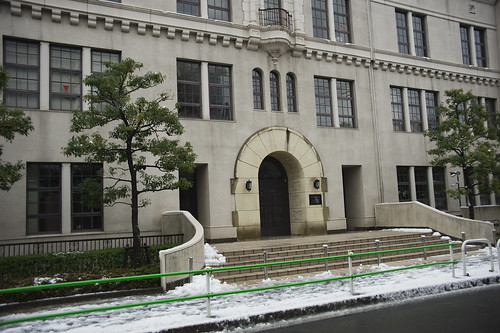
Location profile #1 ~ Tōyo Eiwa Girls Academy

The Tokyo presented in Sailor Moon actually exists. The buildings and locations presented to the viewer, though renamed, are actual locations, painstakingly copied in order to give the Japanese audience the feeling that Sailor Moon may actually walk among them. In honour of Naoko Takeuchi's beautiful and tireless representation of the real Tokyo, scattered throughout this blog will be location profiles; posts on the cultural history and meaning of the places that the Senshi call home.

Rei Hino attends the T*A Private Girls Academy" which is based upon the well known Tōyo Eiwa girls school in Azabu- Jûban a short walking distance from the shrine upon which Rei's home is based in the manga. The school was established in 1884 and encompasses all grades from Kindergarten to grade school and is well considered in Japan as a training school for well-bred young women. Originally created by Canadian methodist missionaries the school began with just two students. However, as time went on more and more girls enrolled and the school expanded. Sadly, the main buidling of the school was demolished due to disrepair in 1993, however the logo of Rei's school matches the logo present on the main school building before this date.

In the manga and anime, Rei's school is presented as being Catholic rather than methodist, this aside though, why would a clearly Shinto shrine miko such as Rei be attending a Christian school? The Japanese education system of assessment relies very heavily upon which school you go to. If you can attend a well thought of school and get high grades, then this is seen as a higher achievment than attending a less well thought of school and recieving the same grades. This may partially explain why Rei is willing to attend a religios school which does not follow her faith.

Also, T*A Private Girls Academy is a well considered private school. Rei's father is a successful politician and it may be that he seeks to further his own career and reputation by sending his daughter to an exclusive and probably expensive school.

Rei however seems happy at her school. Dispite scenes of bullying from her school mates during her introductory episode (both in the manga and the anime), when we see Rei at school later on in the story she appears to have a group of worshipers and is fully engaged in school activities such as the culture festival.

 Tōyo Eiwa Girls Academy still teaches to this day although now in the new building pictured above which sadly looks less like Naoko Takeuchi's artwork of the school.

Friday, 4 February 2011

How long is Henshin?

The length of Henshin, otherwise known as transformation, is an issue which has sparked many arguments between Sailor Moon fans all over the world. There are several different theories, the main three of which i will discuss in this post. The main issue is that the audience is shown a lengthy sequence in which one of the senshi goes from normal girl into Sailor Warrior involving lots of sparkles, twirling and mystical make-up application. This long-winded change of clothes appears unlikely to some, as they point out, why would an enemy simply sit and wait while a warrior becomes stronger?

The purist: The purist theory states that the henshin is exactly as it appears. This theory is fairly uncommon as it does not explain the time lapse between the start of transformation and the actual beginning of combat. It could be argued though that as the senshi rarely tranform in front of an enemy this does not present a regular problem.

The Slow-mo: Some state that the henshin is infact as it appears but so much faster that in real time it would be instantaneous, thus it is shown in slow-motion. This theory does make sense and explains why an enemy would not react. It also explains why when seen externally, the henshin does indeed appear to be instantaneous.

The Multi-Dimensional: This theory revolves around the existance of two dimensions. One is the reality that we know and the other is where the henshin takes place. The idea is, that the act of transformation allows the senshi to side-step into a seperate reality where time is a different deal. Almost like Narnia, minutes there are seconds here and this allows the henshin to take place uninterrupted at the shown pace.

These three theories are all perfectly valid and i do not feel that there is actually a solid answer to the debate without consulting Naoko Takeuchi herself. However, transformation sequences are a common factor in many magical girl anime and it may simply be that the length and presentation is not an issue of storyline.

Personally i am stuck between slow-mo and Multi-dimensional as i feel that the purist theory leaves too many issues open for my liking. However, as alway, the issue remains an open one and one i expect to see being argued in forums for many year to come.

Thursday, 3 February 2011

Character Profile #11 ~ Mamoru Chiba A.K.A Tuxedo Kamen

Mamoru Chiba is the only male main character in Sailor Moon. He is the handsome prince to Usagi's beautiful princess and is directly based upon Naoko Takeuchi's idea of the perfect man. Orphaned at a young age and suffering from amnesia he seeks the Silver Crystal, not even truly knowing what it is, in order to remember himself. This means that to the Senshi he is an enemy at first although he continually saves Sailor Moon. He is a cool customer, intelligent and well off living in a large and well kitted out apartment in an expensive part of Tokyo.

In the manga, Mamoru is a high school student who rides the bus to get about whereas in the anime he is in university and owns a motorbike and a car. This may be because in the anime, the locations used are further apart and the age difference between himself and Usagi is more interesting. In the live action he is a student who is actually engaged to a young woman who's family helped him as a young orphan, this causes romantic tension when he falls in love with Usagi.

Being the main male influence in the story it is important that Mamoru is neither over whelming, nor too soft and maleable by the large and penetrating female side. Takeuchi strikes this balance by keeping him largely seperate from the other characters; only appearing when they are in dire need or when he is required for the purposes of furthering the romantic storyline.

Unlike the Senshi, who's characters stand alone, Mamoru relies upon the character of Usagi for his existance in the story. This does not mean that his character is weak but more that it furthers a different storyline from the other Senshi, one which requires two people. A love story. This love story runs through the entire Sailor Moon saga ending with the marriage of Usagi and Mamoru and the eventual birth of Chibiusa. It provides not only a substory to follow alongside the main plot, but also something for Usagi to fight for other than the altruistic goal of saving the world.

"Follow your path without fear" - Mamoru Chiba

Wednesday, 2 February 2011

Character Profile #10 ~ Hotaru Tomoe A.K.A Sailor Saturn

Name: Hotaru Tomoe
Birthday: January 6th
Sign: Capricorn
Bloodtype: AB
Fave colour: Violet
Hobby: Reading & Collecting lamps
Fave food: Japanese Soba
Least fave food: Milk
Fave subject: World History
Least fave subject: Gym
Weaknesses: Marathons
Special talent: Healing wounds
Dream: Nurse

Hotaru Tomoe is a fragile character, both physically and mentally. She has no friends in her age group and suffers from a respiratory disability stemming from the fire which almost took her life as a small girl. To add to her own frailty she is being utilised by her father, the one man who should love her, to raise the evil spirit of Mistress 9. This depiction of parental betrayal is difficult to stomach, however, Hotaru's addition to the story fulfills some important requirements. First there is her role as the new super villain after Wiseman and Queen Beryl. She is though, different to these previous characters in that she has the potential to become a good character and is innocent of the evil within. This makes the battle against her complex, adding a new dimension to the usual, straight-laced good vs. evil plot line. Second, she provides a special friend for Chibiusa, especially after Hotaru's reincarnation where she fits into Chibiusa's age group. Chibiusa, although friends with the other senshi is at a disadvantage due to her age and never quite fits into the group completely. There was a need therefore, for her to find a friend who could be more at her own level. The enrolment of Hotaru into the senshi later in the series, completes this need.

Third, Hotaru is a new type of Senshi. The others have their emotional, cultural and sociological problems but Hotaru is a physically disabled character. Although after her reincarnation this part of herself is lost, it is my belief that her original physical state is an important part of her personality type. She is understanding of others with difficulties and tries very hard to fit in. She is quite shy and is often sad. These traits may be informed by her inability to control her own body like others.

Hotaru is also known as the "Goddess of death and destruction". It is her job to bring an end to worlds and societies. The last kingdom to feel the swing of her scythe was the Silver Millenium and throughout episodes leading to her awakening we are led to believe that the next one will be Earth. This however is not the case and instead of allowing Earth to be destroyed, Hotaru throws herself into her own attack; destroying Mistress 9, Pharoh 90 and their minions as well as sacrificing herself. Why?

The obvious and practical answer is that if she had not done this then the Senshi would have died and the Earth would be lost, thus ending the Sailor Moon saga for good in a rather upsetting and unsatisfying "Neon genesis Evangelion" - esque way. Within the context of the story though a different answer come to light. Love. Hotaru and Chibiusa have become good friends over the story leading to this point, perhaps it is this that saves the world as Hotaru can not bear to see her friend hurt. Or perhaps it is that, like Sailor Pluto, Sailor Saturn has some higher knowledge and is somehow aware that now is not the time for the world to end. Either way, it is through Hotaru's sacrifice that the world is saved; somewhat of a departure from the usual heroic antics of sailor Moon and her friends.

Sailor Saturn is the antithesis of Sailor Moon. Instead of a Queen of love and light, she is a reflection of darkness and death but this in itself is the nessecary flip-side. Hotaru is the shadow that comes with the light or the other side of the coin and yet she is our friend.

"I thought i was going to die all alone" - Hotaru Tomoe

Tuesday, 1 February 2011

Character profile #9 ~Michiru Kaiō A.K.A. Sailor Neptune

Name: Michiru Kaiō
Birthday: March 6th
Sign: Pisces
Bloodtype: O
Fave colour: Marine Blue
Hobby: Collecting make-up
Fave food: Sashimi
Least fave food: Kikurage
Fave subject: Music
Least fave subject: None
Weaknesses: Sea Cucumbers
Special Talent: Violin
Dream: Violinist

Michiru Kaiō is a classmate of Haruka. A young artistic genius, she paints, writes and is also a virtuoso violinist. Although she is the same age as Haruka (late teens), she is a more mature character, acting with great elegance and adding an adult seriousness to the pair’s murderous mission. 
Michiru is the Senshi of water and this is represented in her personality which is calm and smooth with a dangerous undercurrent of determination and raw power. This tenacity of spirit is what (in the anime) leads to Haruka joining her quest for the talismans. Also combined in Michiru’s character is a deep sadness born of the need to destroy life in order to save it. Whereas Haruka merely buries the pain and pushes it aside, Michiru bears it and expresses it through her artworks. This juxtaposition between the attitudes of a couple that are supposedly lovers, leads to conversations which make the viewer aware that neither girl is comfortable with their mission. This is a vital realisation as without it the pair may be misjudged as heartless, leading to the dislike of their personalities. It is important that the audience feel some form of sympathy for them in order for the story to carry any kind of emotive factor.
Michiru is one of the few Senshi who gains a strong relationship with Ami. This may be because they reflect one another s intelligence and both have a love of water, Ami being the Senshi of ice. This is a nice twist for Ami, as Michiru boosts her confidence and allows her character to grow instead of stagnating in a pool of self- denial and lack of esteem. It is not her relationships or interactions with other characters which make her popular however. I feel it is her sensual and spiritual air along with the internal battle between constraint and liberty which make her character so fascinating.
In her everyday life, Michiru is the very embodiment of freedom. She stands in pagodas in the moonlight, playing her violin with the wind in her hair. However, she is tied to her mission as a senshi; one which will take her life, the life of her lover and potentially many more. She is shackled to this reality, not even released by her art with which she produces only the appearance of autonomy.
It may therefore be unsurprising that her relationship with Haruka is so close, as together they stand even against the other Senshi, to perform the unforgivable in order to protect everything.  Her character shows that even the sensitive can be great in strength and that loving and fighting are never mutually exclusive.
"Only you and I can do this" - Michiru Kaiō

Monday, 31 January 2011

Character Profile #8 ~ Haruka Ten'ō A.K.A Sailor Uranus

Name: Haruka Ten'ō
Birthday: January 27th
Sign: Aquarius
Blood type: B
Fave colour: Gold
Hobby: Driving
Fave food: Salad
Least fave food: Natto
Fave subject: Gym
Least fave subject: Modern History
Weaknesses: Confessions of love
Special talent: Racing
Dream: To be a Racer
Haruka Ten'ō is oft misjudged both inside the series and outside in the fandom. Her character design is based around Takeuchi's desire to introduce a personality resembling a performer from the Takarazuka Revue  tradition of Japanese theatre. This theatrical style is characterised by an entirely female cast, hence Haruka's slightly masculine appearance; many of the female performers play men.

Haruka is a tomboy; more so than Makoto, in that she also dresses in men's clothes. It is perhaps unsurprising that in the beginning Minako and Usagi mistake her for a him. However, dispite allowing the other characters n the story to make certain assumptions about her gender, Haruka never actually outright claims to be male. This prevents the audience from believing her to be transgender and cements the fact that she is merely what she is and not bothering to conform to traditional feminine ideals.

Perhaps most misunderstood is her relationship with fellow Senshi, Sailor Neptune. The American dub pinned them (insulting cousins everywhere!) as cousins but they were originally written as lovers and this is obvious in the way in which they treat one another. Although their behaviour was never explicit, it is always strongly hinted that they are an item. There is a wide range of dōjinshi and fanfiction available on the couple but it is my feeling that their relationship is stronger than simply the sexual aspect. In the anime, it is Neptune who recruits Haruka to the Senshi and their interaction seems to be one of mutual support in a difficult and unforgiving world.

Haruka and Neptune are introduced to the story as seeking the three Talismens which reside in the pure hearts of individuals. They, unlike the inner Senshi, are in their late teens and have a more cynical and jaded perception of the world around them. For the greater good they are willing to kill innocents, a tactic which does not sit well with the other Senshi. This allows Neptune and Uranus to act almost as renegade Senshi, exposing the first true rift between the Senshi of the Silver Millenium. This gives us a much more interesting storyline, asking the viewer a moral question; whose ideals do you support?

Haruka is a more complicated character than her easy going exterior would suggest. We know that she is capable of deep feelings for those around her and yet she is willing to kill or die to achieve her goals. This suggests a great inner conviction to do what she feels is right. Haruka is an almost perfect reflection of the human conscience; You know what is right, but do you have the strength to do it?


                                                         "I never said that i'm a man!" - Haruka Ten'ō